Updated: July 2026
A Complete Phinisi Boat Price Guide for Prospective Owners
- Construction & Size: The choice between an ironwood and teak hull, overall length (LOA), and the complexity of the design are primary cost drivers.
- Build Type: A new, custom build offers complete personalization over 12-24 months, while a brokerage phinisi provides immediate ownership.
- Finishing & Systems: The quality of interior materials, brand of marine engines, and sophistication of navigation systems significantly impact the final valuation.
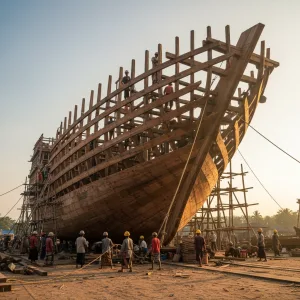
The air in the boatyards of Tanah Beru, South Sulawesi, is thick with the scent of sawdust, clove cigarettes, and the salty breeze rolling off the Flores Sea. Your bare feet feel the texture of teak shavings on the ground as you stand in the shadow of a half-built hull, its ironwood ribs arching towards the sky like the skeleton of a great whale. The rhythmic thud of wooden mallets striking chisels is the only percussion. This is the birthplace of the phinisi, a vessel born from centuries of maritime tradition. The romance is palpable, the craftsmanship undeniable. But as you run a hand along the smooth, curved planking, the practical question surfaces: What does it actually cost to commission or acquire one of these magnificent ships?
The Spectrum of Investment: From Project Boats to Superyachts
Understanding the phinisi market requires appreciating its vast price spectrum, which spans from accessible project boats to floating palaces that rival European-built yachts. At the entry-level, from approximately $150,000 to $400,000, one can find older, smaller brokerage vessels. These are typically under 25 meters in length and may have been in service for over a decade. While the price is tempting, prospective buyers should budget an additional 50-100% of the purchase price for a comprehensive refit, which often includes engine overhauls, new generators, and a complete interior refresh. In this range, you are buying potential, not a turnkey charter operation. Moving into the mid-range, from $400,000 to $1.2 million, the options expand considerably. This is the heart of the successful private charter market, featuring phinisis between 30 and 40 meters with 5 to 7 well-appointed cabins. A vessel in this price bracket might be a recently built phinisi from a reputable but less famous yard, or a 5-year-old boat from a top-tier builder that has been impeccably maintained. The high-end of the market starts around $1.2 million and can extend beyond $4 million. Here, you are entering the realm of new, custom-built luxury phinisis. These vessels often exceed 45 meters and are constructed with the finest, legally-sourced hardwoods, equipped with state-of-the-art navigation systems, and feature interiors conceived by professional designers. The ultra-luxe phinisis, sometimes called “phinisi superyachts,” can command prices upwards of $5 million, boasting steel hulls for greater durability, multiple decks, onboard spas, and the capacity for long-range, autonomous expeditions through the archipelago.
Deconstructing the Build Cost: Hull, Machinery, and Interior
For those commissioning a new vessel, the price is a composite of three core elements: the hull and superstructure, the machinery and onboard systems, and the interior fit-out. As a general rule, the breakdown is roughly 40% for the hull, 30% for machinery, and 30% for the interior, though the latter can fluctuate wildly based on taste. The hull is the soul of the phinisi. “You don’t compromise on the wood,” explains Pak Hasyim, a fourth-generation boat builder from Bira whose hands have shaped more than 30 hulls. “The keel must be single-piece ironwood (Kayu Ulin), and the frames too. It is the foundation. For the planking and decks, we use the best old-growth teak (Jati).” Sourcing this certified, high-quality timber is a significant portion of the hull cost, which for a 40-meter boat can easily exceed $500,000. The machinery component is the vessel’s heart and nervous system. This includes main engines—twin marine diesels from brands like Yanmar or Mitsubishi are the industry standard—costing anywhere from $60,000 to $200,000 for a pair. Add to this multiple generators, high-capacity water makers, robust air conditioning systems, and a full suite of marine electronics, and the budget for systems can quickly approach the cost of the hull itself. Finally, the interior fit-out is where the owner’s vision truly takes shape, and where costs are most variable. A simple, clean design using locally sourced woods and textiles might cost $20,000 per cabin, whereas a luxury suite with imported marble, designer fixtures, and custom-milled joinery can cost over $150,000 for a single room.
New Build vs. Brokerage: The Time and Money Equation
The decision between commissioning a new phinisi and purchasing a pre-owned one is a fundamental choice between customization and convenience. A new build offers a blank canvas. Every bulkhead, cabin layout, and design detail is yours to decide, resulting in a vessel perfectly tailored to your vision, whether for private use or a specific charter niche. This process, however, is a significant commitment. A typical 35-meter phinisi requires 18 to 24 months from the keel-laying ceremony to its maiden voyage. This timeline demands patience and active project management, often requiring multiple visits to the boatyard to oversee progress and make critical decisions. The payment structure is typically tied to construction milestones—a 30% deposit to secure materials, followed by payments upon hull completion, engine installation, and final delivery. Conversely, the brokerage market offers the allure of immediate gratification. A pre-owned phinisi can be acquired and operational in a matter of months, not years. This route often presents a better initial value, as the steep depreciation of a new vessel has already been absorbed by the first owner. You also gain the benefit of a proven platform with an established operational history. However, this convenience comes with compromise. You inherit the previous owner’s design choices and layout. Furthermore, a thorough pre-purchase survey by a qualified marine surveyor is non-negotiable. This can cost between $2,000 and $5,000 but can save you hundreds of thousands by uncovering hidden structural or mechanical issues. Many brokerage boats will require a refit to match your standards, which can range from a modest $50,000 cosmetic update to a $500,000+ structural overhaul. Exploring the available phinisi boat for sale listings is the best way to understand the current market’s offerings and price points.
The Hidden Ledger: Operational Costs and Charter Realities
The purchase price is just the first chapter in the financial story of phinisi ownership. A prudent prospective owner must budget for annual operational costs, which experienced operators calculate at 10-15% of the vessel’s insured value. For a $1.5 million phinisi, this translates to an annual budget of $150,000 to $225,000, before a single charter is booked. The largest single expense is crew. A 40-meter phinisi operating in a region like Komodo or Raja Ampat requires a professional crew of 12 to 18 members, including a captain, cruise director, chief engineer, chef, dive guides, and stewards. The monthly crew payroll can easily range from $10,000 to $20,000. Insurance is another major line item, with comprehensive hull and liability coverage typically costing 1-1.5% of the vessel’s value per year. Maintenance is relentless. Indonesian maritime law requires commercial vessels to undergo an annual dry-docking for inspection, cleaning, and antifouling paint, a procedure that can cost between $30,000 and $100,000 depending on the work required. Add to this fuel (a week-long charter can consume over 5,000 liters), provisions, and mooring fees at various ports, and the costs accumulate quickly. To offset these expenses, a well-managed phinisi can generate substantial charter revenue, with nightly rates ranging from $3,000 for a comfortable mid-range boat to over $15,000 for a top-tier luxury vessel. The key to profitability is occupancy; a successful charter phinisi aims to be booked for 20 to 25 weeks per year, a goal that requires a superb crew and a world-class marketing effort.
Legalities: Flagging, Permits, and Ownership Structures
Acquiring a phinisi is not just a financial and logistical challenge; it is also a legal one. To operate commercially and charter within Indonesian waters, a vessel must fly the Indonesian flag. This presents a hurdle for foreign buyers, as Indonesian law restricts direct vessel ownership by non-citizens. The established legal pathway for a foreigner is to set up a foreign direct investment company, known as a PT PMA (Penanaman Modal Asing). This Indonesian-domiciled company, which can be majority foreign-owned, legally owns and operates the phinisi. The process of establishing a PMA is complex and bureaucratic, requiring expert legal counsel and an initial investment of $10,000 to $25,000 in setup fees. Once the company is formed, it must secure a portfolio of licenses, including a general business license (SIUP), a tourism license, and specific charter permits from the Ministry of Transportation. This framework, while complex, provides a secure and legal structure for ownership and operation. It’s also vital to appreciate the cultural heritage you are becoming a custodian of. The art of boatbuilding in South Sulawesi, which you can read about on indonesia.travel, is a living tradition. This craft is so integral to the nation’s identity that it was inscribed in 2017 on the UNESCO Representative List of the Intangible Cultural Heritage of Humanity. Owning a phinisi means participating in and supporting this remarkable legacy.
Quick FAQ: Your Phinisi Questions Answered
How long does it take to build a phinisi?
A standard 35-40 meter phinisi typically takes 18 to 24 months from keel laying to sea trials. Smaller boats under 30 meters can be completed in as little as 12 months, while larger, highly customized projects can easily exceed 30 months, depending on the complexity of the interior and systems.
What is the best wood for a phinisi hull?
The gold standard for the keel, frames, and key structural components is Ironwood (Kayu Ulin), a Bornean timber renowned for its incredible density and natural resistance to marine borers and rot. The hull planking, decks, and superstructure are almost always constructed from high-grade, sustainably sourced Teak (Kayu Jati), prized for its durability and beauty. You can learn more about the history on Wikipedia.
Can a foreigner legally own a phinisi in Indonesia?
Yes, though indirectly. The most common and secure legal method is to establish a foreign-owned investment company (a PT PMA) in Indonesia. This Indonesian legal entity then owns the vessel, allowing it to be flagged in Indonesia and operated legally as a commercial charter business within the country’s waters.
Is buying a phinisi a good financial investment?
It should be viewed primarily as a passion investment and a business venture, not a passive asset. A well-marketed and professionally managed phinisi in a prime location like Komodo National Park or Raja Ampat can generate a positive cash flow and a reasonable return on investment. However, it requires significant capital, active management, and a deep understanding of the luxury tourism market.
The path to phinisi ownership is as intricate as the carvings on its transom, a journey that demands due diligence, patience, and a significant financial commitment. Yet, the reward—the singular freedom of navigating your own handcrafted vessel through the world’s most vibrant archipelago—is immeasurable. For those ready to take the next step from dream to reality, the first port of call is to understand the landscape of what is currently available. We invite you to begin that journey by exploring our curated listings of phinisi boat for sale and discovering the vessel that awaits you.
Related reading