
Phinisi Boat For Sale

Crew

The Crew Is Why a Guest Books Twice

A phinisi needs Indonesian maritime competence and international hospitality in the same crew. Placed into managed charter, a vessel runs on the same crews and standards as the group’s own fleet — which is the part of the offer that is hardest to build from scratch.

Crew of 7
Published on VIP I, 31 m · 12 guests
30 guests
Largest capacity on the book
Certified
Basic safety training, current
Shared
The fleet’s own crews and standards

Quick answer

Crew size follows guest capacity, not length. VIP I carried a crew of seven for twelve guests; a hull carrying thirty guests across sixteen cabins needs materially more, and needs them rotated.

  • Certification is checked at survey rather than assumed — currency lapses quietly.
  • Rotation means the payroll count is higher than the number aboard on any given week.
  • A vessel placed into managed charter inherits an existing crew network instead of recruiting one.

Compensation is quoted per vessel

This page carries no salary bands. The previous version published nine of them — captain through junior steward — with no source behind any figure, and crew pay moves with rotation pattern, certification level, charter tips and season. The desk quotes a crew budget against a named hull and a named calendar.

Sizing it

Crew Follows Guests, Not Metres

Two vessels on our book are both 38 metres. One carries thirty guests across sixteen cabins; the other carries 21–25 across eight. They are not the same crewing problem, and length tells you nothing about which is which.

The only crew number the group publishes is on VIP I: a crew of seven for twelve guests on a 31-metre hull. Treat it as the one real data point and scale the conversation from there rather than from a table.

VIP I · 31 m 12 / 5
Crew of seven, published. The only sourced crew number on the book.
VIP II · 22 m 12 / 5
Same guest load on a shorter hull — comparable service demand
VIP III · 27 m 20 / 7
More cabins to turn over between legs
VIP IV · 27 m 20 / 10
Ten cabins on 27 m — the highest cabin density here
VIP VI · 38 m 21–25 / 8
Every cabin ensuite, jacuzzi deck — service-heavy rather than berth-heavy
VIP V · 38 m 30 / 16
The largest crewing problem on the book by a clear margin
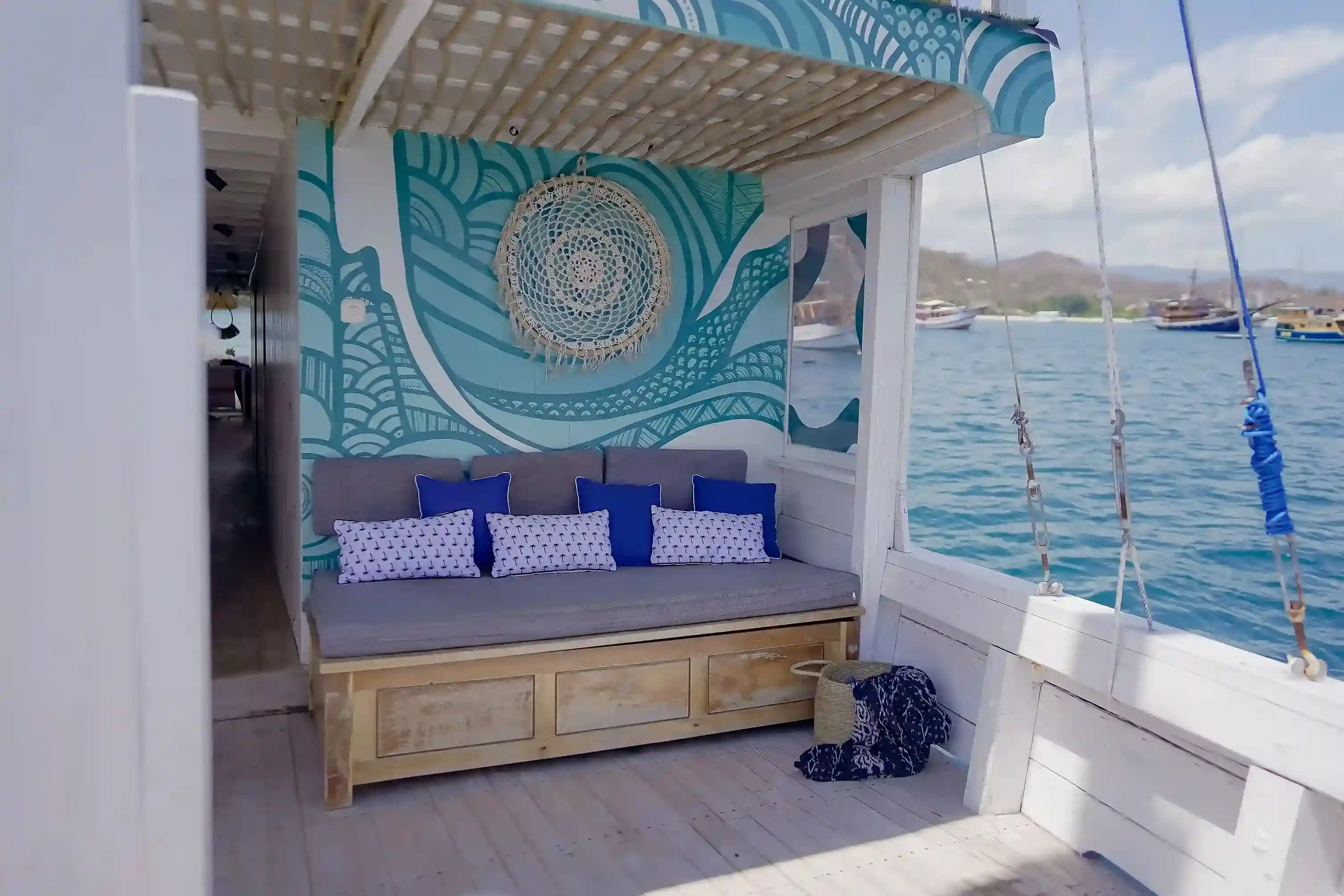
The shaded deck lounge of a phinisi at anchor

Certification

What Every Crew Member Must Hold

Currency matters as much as possession. A lapsed certificate is an insurance problem before it is a safety one.

  • Required

    Basic safety training

    The foundation certificate for anyone working aboard a commercial vessel — fire, survival, first aid, personal safety. Checked for currency, not just for existence.

    Every crew member

  • Required

    Medical certificate

    Current fitness-to-work certification for seagoing duty.

    Every crew member

  • Required

    Certificate of competency

    The captain and engineers hold competency certification appropriate to the vessel’s tonnage band and the waters worked. Every phinisi on our book sits in the Pas Besar band, 7–500 GT.

    Captain and engineers

  • Conditional

    International watchkeeping standards

    STCW certification applies according to the vessel’s flag, tonnage and trading area. Which parts bite is a question for the flag administration rather than an assumption.

    Depends on flag and trading area

  • Conditional

    Pollution prevention

    MARPOL compliance and the crew training that supports it, according to the vessel’s certification.

    Per vessel certification

  • Conditional

    Diving supervision

    A vessel running dive charters carries a certified divemaster, and a dive-focused operation usually carries a second plus a compressor technician.

    Dive operations only

  • Conditional

    Immigration status

    Any non-Indonesian crew member needs the correct work authorisation, which is a separate question from their maritime certification.

    Foreign crew · Immigration

Certification requirements depend on the flag, the tonnage band and whether the vessel carries paying guests. Confirm the applicable set against your own vessel and intended operation.

Where crew come from

Three Labour Pools, Three Different Skills

A phinisi crew is assembled from communities that do not overlap, which is why building one from scratch takes years rather than months.

Deck and engineering

The shipwright communities

Bira and Tana Beru in South Sulawesi, where the hulls are built. Deckhands and engineers often come from boatbuilding families, which means they understand the vessel as a structure and not only as a workplace.

Captains and officers

The Labuan Bajo maritime workforce

The Komodo gateway, and where the charter fleet actually operates. Senior officers here know the anchorages, the currents and the park procedures because they work them every week.

Front of house

The Bali hospitality industry

Stewards, chefs and front-of-house. This is the pool that decides whether a guest describes the trip as a boat or as a hotel, and it is the hardest of the three to recruit into a rotation.

Crew plan

Ask for a Crew Budget Against a Hull

Tell us which vessel and which calendar and the desk builds the crew plan against it — composition, rotation, certification status, and what it costs. A vessel going into managed charter inherits the network rather than recruiting one.

Or call +62 811-3941-4563

  • Composition and rotation sized to the guest capacity
  • Certification status audited, not assumed
  • Managed charter inherits existing crews and standards