


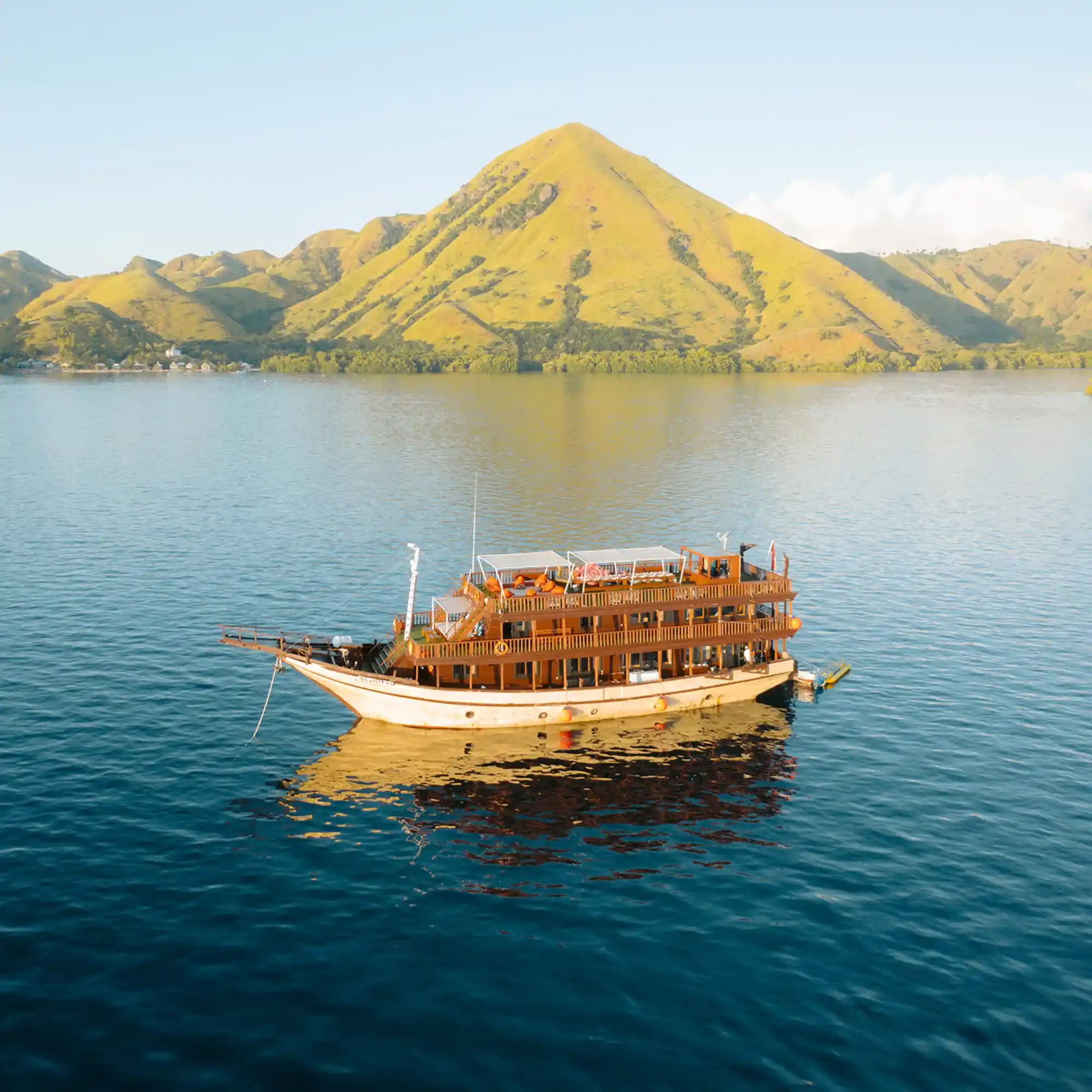

Cabin Count vs Stability: When More Berths Means More Risk
Updated: August 2026
Every cabin added above the main deck of a phinisi raises the centre of gravity and reduces stability margin. A listing advertising an unusually high berth count for its length has usually gained those berths by building upward. Ask for the stability booklet and the date of the last inclining experiment before you treat the extra cabins as value.
The physics, briefly and without the mathematics
A vessel stays upright because its centre of buoyancy shifts outboard as it heels, generating a righting moment against its centre of gravity. Anything you add high in the vessel — an upper deck cabin, an enclosed sky lounge, a heavier tender on the sun deck — raises the centre of gravity and shortens the lever that keeps her upright. Anything you add low, such as ballast or fuel in bottom tanks, does the opposite.
Traditional phinisi hull forms are beamy and initially very stable, which is part of why they feel so solid at anchor. That same characteristic makes it tempting to keep building upward, because the vessel does not obviously protest. The margin erodes silently until a beam sea, a full guest complement on the top deck, and low fuel coincide.
What the listing is really telling you
Compare berth count against registered length across your shortlist. A twenty-eight metre hull offering twelve guests in six cabins is unremarkable. The same length offering eighteen guests in nine cabins has found that volume somewhere, and on a phinisi it is almost always upward or by converting crew space. Both have consequences: the first for stability, the second for service quality and crew retention.
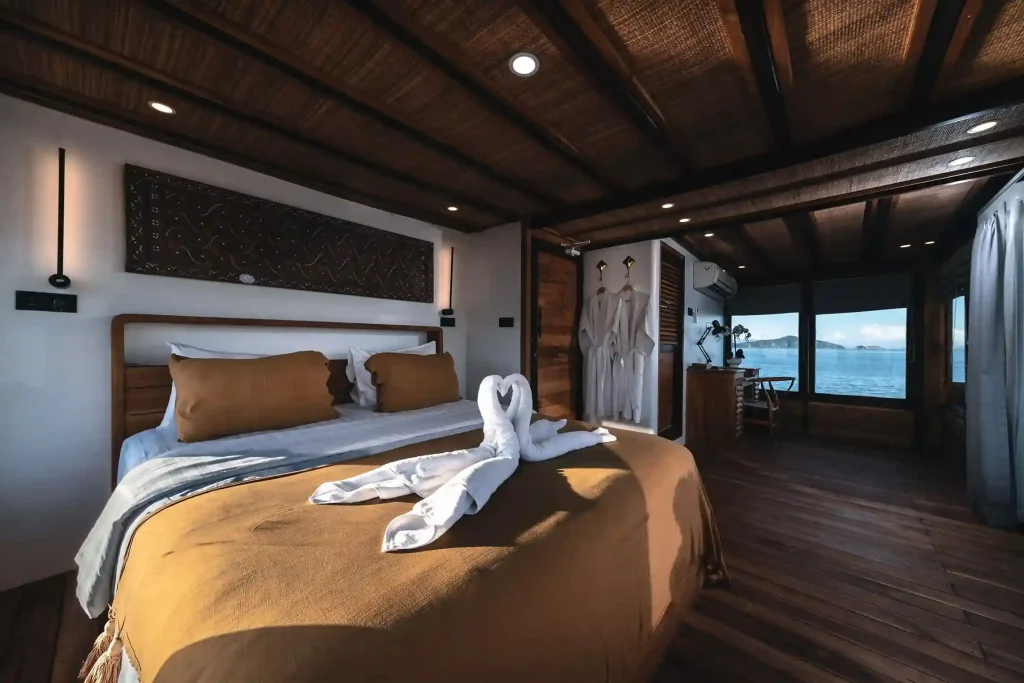
- Upper-deck cabins — the classic stability cost, and the most valuable cabins commercially, which is why they keep getting built.
- Enclosed sky lounge — adds weight high and enclosed volume, which also changes gross tonnage; see tonnage certificates explained.
- Converted crew quarters — no stability cost, but the crew end up sleeping in the saloon, and the charter reviews follow.
- Saloon convertibles counted as berths — inflates the advertised guest number without adding a single private cabin.
The documents that settle it
Three papers matter. The stability booklet contains the calculations for defined loading conditions and is the document a competent surveyor will want first. The inclining experiment report records the physical test used to establish the vessel’s actual centre of gravity, and its date tells you whether it predates the modifications you can see in the photographs. The general arrangement plan shows where the mass sits — see reading a GA plan.
A vessel that has gained an upper deck since its last inclining experiment has no current evidence that it remains within its designed stability envelope. That is a survey finding, not a paperwork irritation, and it is worth an independent naval architect’s opinion before purchase.
What a surveyor should check on board
- Freeboard against the drawn waterline, with tanks in a known state.
- Weight added since build: tenders, dive compressors, water sports equipment, generators, battery banks.
- Downflooding points — where water enters if the vessel heels far enough — and whether they can actually be closed.
- Bilge pumping capacity and whether alarms function.
- Watertight subdivision, and whether any bulkhead has been pierced during refit without proper reinstatement.
Commercial consequences
Stability is not only a safety question; it is a certification question. A vessel carrying paying guests must satisfy the operating requirements for its trading area, and stability documentation is part of that file. A hull whose paperwork no longer matches its physical configuration can find its certificate difficult to renew, which is a far more disruptive problem for a new owner than any refit item. Factor it into the offer, and read refit records review for the evidence standard that applies to any claimed structural work.
How to weigh berths against margin
Charter economics reward cabins, so the pressure is always upward. The judgement is whether the berths were added by a yard working to a naval architect’s drawing with a fresh inclining test afterwards, or by a carpenter working to an owner’s sketch. Both produce cabins. Only one produces cabins you can insure, certify and sleep in without reservation.
Request the vessel dossier
We state cabin count, berth count and stability documentation status separately on every dossier. WhatsApp +62 811-3941-4563 or write to [email protected]. All figures on this site are quoted in USD.
Frequently asked questions
Does adding a cabin to a phinisi affect stability?
Yes, if it is added above the main deck. Weight high in the vessel raises the centre of gravity and reduces the righting lever, shortening the stability margin. Weight added low, such as ballast or bottom-tank fuel, has the opposite effect.
What is an inclining experiment?
A physical test in which known weights are moved across the vessel and the resulting heel is measured, allowing the actual centre of gravity to be calculated. It is the basis of the stability booklet, and it should be repeated after significant structural modification.
How many guests should a 28-metre phinisi carry?
Around twelve guests in six cabins is a normal, comfortable configuration at that length. Substantially higher numbers usually mean upper-deck construction, converted crew space, or saloon convertibles counted as berths — establish which before valuing the extra capacity.
Can a vessel be refused certification on stability grounds?
Certification for guest-carrying operation depends on a documentation file that includes stability evidence. If the physical vessel no longer matches its stability documentation, renewal becomes difficult until the position is corrected, which can take months.
Phinisi Boat For Sale is a specialist maritime brand and digital platform under Juara Holding Group. Vessel-sale, construction, refit and repair contracts are issued by PT Komodo Galangan Nusantara. Brokerage, central agency and charter-marketing contracts are issued by PT Komodo Bahari Nusantara. Separate contracts, separate fees, separate ledgers.
You may also like


Written and checked by the desk. Figures are dated at the point of writing — our editorial standards explains how, and what happens when something here turns out to be wrong.